In many ways, water frames my life. It’s an obsession of mine.
The Weather Obsessive Goes Soft
The winter of 1977-1978 dumped feet of snow on Kentucky. One notable blizzard led to my birth 9 months later.
As a child, the floods throughout eastern Kentucky were just a fact of life: It rained too hard, and the rivers backed-up, usually in the community of Wolverine. People who lived there would get flooded at least once a year for days. Then in 1991, former governor Bert T. Combs died when he tried to drive home. People would drown.
To a degree, living in Eastern Kentucky is sort of like living in the bay of Naples: You know Vesuvius is right there. You know what’s happened before. But life sort of goes on, you know?
So I became obsessed with weather. Not quite to the degree my roomate Chris would be–Chris could quote the forecast from any weatherstation in the US on demand–but I became obsessed with following the forecast, the risks that were coming, the percentages. Living in Kentucky, this is something of a survival skill, especially with flooding, tornadoes, ice storms, derechoes.
I didn’t realizing how much anxiety was there until I moved to Texas. After that, it sort of…evaporated.
Central Texas Weather
TL;DR: I stopped paying attention to the weather once I moved here. It’s just not that interesting:
- Summer (May -> October): It’s hot and doesn’t rain. There may be African Sahara dust, but it’s usually just bright sunshine 15+ hours a day.
- Winter (October -> April): It’s cooler and can rain.
Cruicially, on the years we’ve been here it’s averaged about 17 - 27 of rain. Remember that number
July 3rd: The Setup
It’s Thursday. We’re on week two of a relocation at work, with our facilities folks playing “Traffic” with hundreds of engineers across multiple buildings. It’s not gone particularly well–two weeks earlier we’d stayed home for 3 days, only to arrive on Monday to find things off, broken, or just plain missing. Moreover, they’d managed to sit well-intentioned “meeting attenders” (Program Managers, Product Managers, and Executive Assistant) in the same aisle as my engineers.
So after a shortened week of this, I was on edge. I told my folks they could go home at 3pm and I stayed until 5. I was looking forward to sneaking away to watch F1: The Movie sometime over the long weekend, which I had to admit was configured perfectly. Friday off, then a Saturday and Sunday. “It’s like Two Saturdays,” I thought.
It’d been raining all day, sometimes hard. Around noon, my wife sent over Signal to our group chat, “It’s raining again! I’m so excited about it!”
“Yeah, rain in July is pretty much unheard-of,” I replied. I didn’t think much about it.
Little did we know how “unheard-of” the next 48 hours would be. Some of the forecasters had an inkling, but the atmospheric models seemed unbelievable: FOURTEEN inches of rain? How was that even possible?
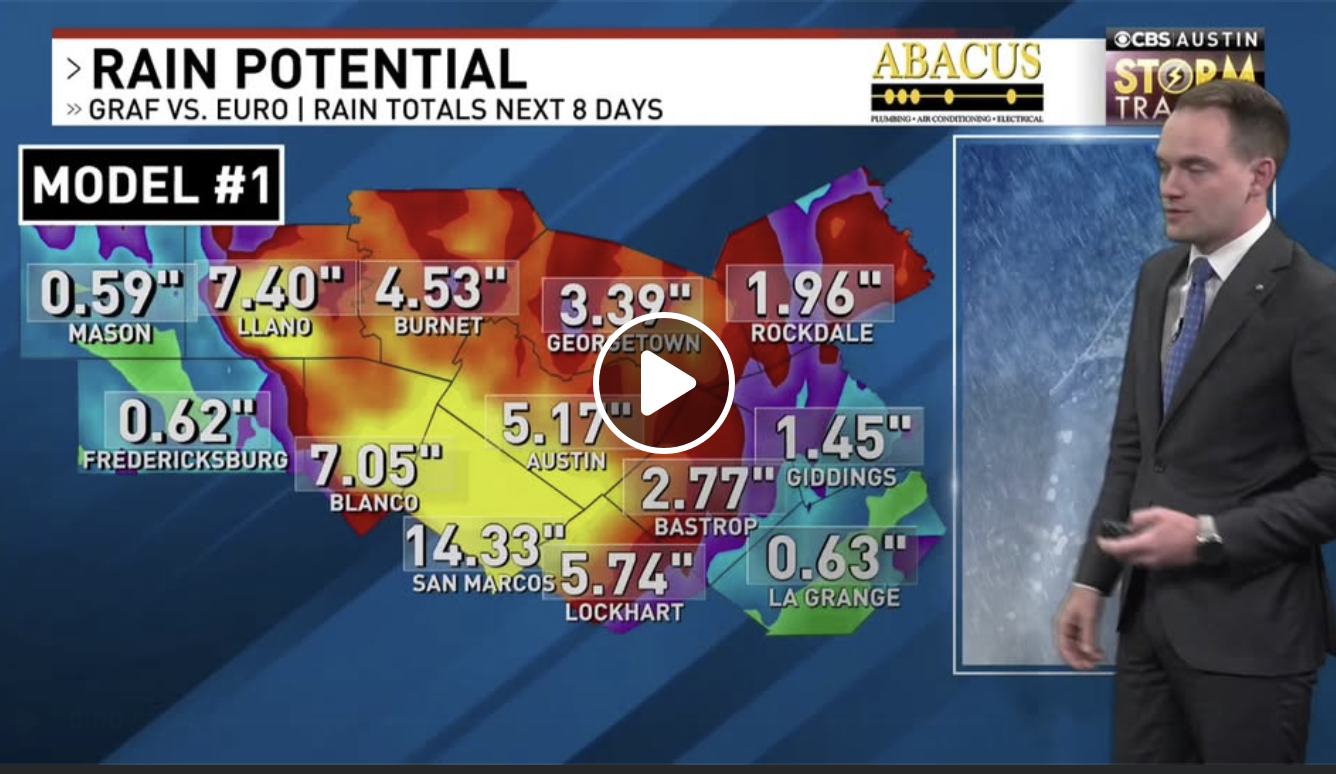
A few things to note how this was a “perfect storm” scenario:
- This is a holiday weekend. Many were off work, away from home, enjoying RV parks or at sleepaway camp. In general, many found themselves in unfamiliar surroundings without instinctive or ready means for escape
- The energy for the rain came from a dead hurricane, shockingly similar to Junger’s account in “The Perfect Storm”. As we’ll see, the storm didn’t behave like any model predicted. As I write this, it still isn’t.
- This is the Texas Hill Country: The terrain seduces. the “Flat” areas here are floodplains or alluvial formations. In reality, this particular areas is an extension of the very Appalachian mountains and piedmont I grew up in. The soils is thin, and the rock beneath pitches to slough-off water, not absorb it.
- In both cases that follow this happened at night.
July 4th: The First Catastrophe
People often think of the Texas Hill Country as a San Antonio phenomenon, but it’s a large area, stretching from Northeast of Austin, far west out to I-10, and then south to SA, making a triangle. The night of Hell began in places with pleasant names like Kerrville, Comfort, Mountain Home, and–heartreakingly–Camp Mystic. These all sit on Creeks and tributaries of the Guadelupe “river”. I put that in quotes, because the Guadelupe, like most rivers in Central Texas, might have a foot of water during its non-drought seasons. The tributary creeks you could walk across.
Then fourteen inches of rain fell.
They all became 25 foot walls of water, hundreds of yards wide. And they did it in under 30 minutes. At this point, we don’t know exactly what happened next. Some people got out, some were swept away. There were heros who sacrificed themselves to save others. Many of them were teenagers at camps like Camp Mystic. I watched an interview with a guy who was at the RV camp something to this effect:
I saw them go. I saw their RV just wash away down the stream. I heard the children scream. There was nothing I could do.
We awoke to this.
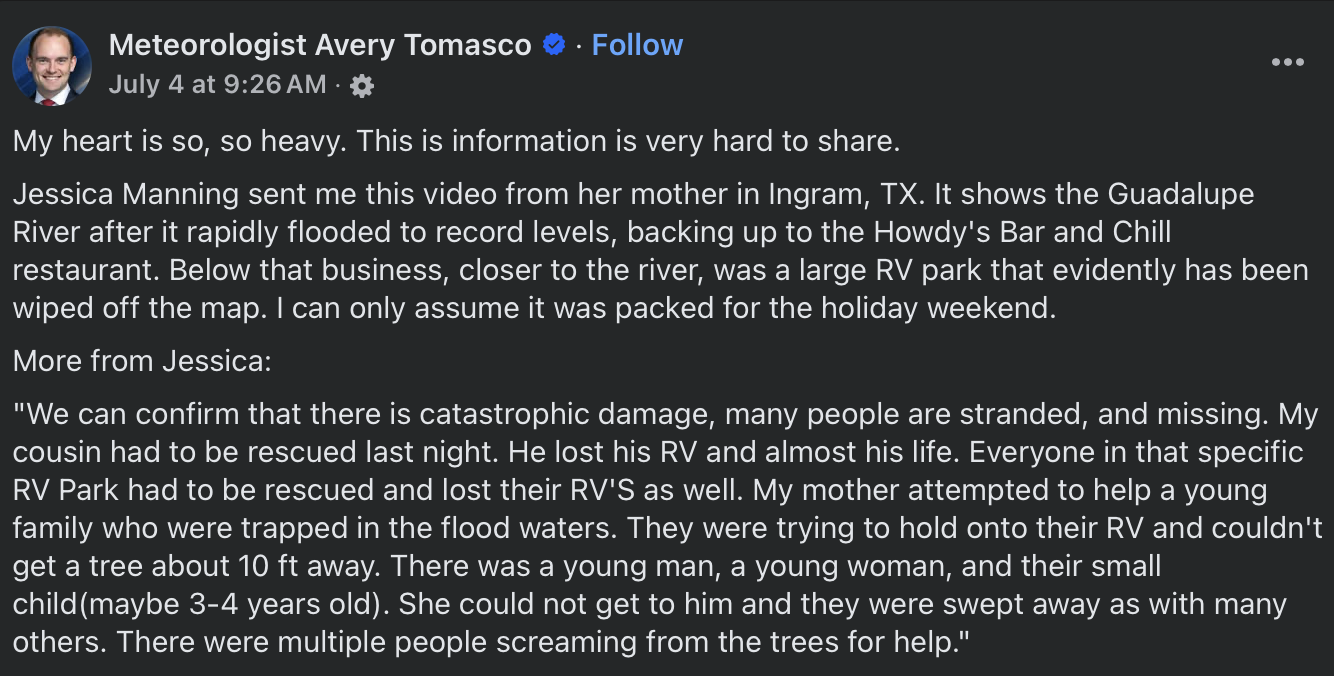
Friends and family of mine reached out–Are you okay? Are Whitney and the girls okay? “Yes, but about 50 miles away people aren’t.” I mechanically got out started doing chores. It’s a ranch–there’s always something needing doing. I let the goats out, made sure they had water, did some badly needed weed-whacking around our mailbox.
Then it started raining. I knew that rain…it wasn’t normal Texas rain which often feels chilly. I even thought to myself, “If I’m gonna get soaked, glad it’s this warm stuff.” Looking back I should’ve realized, I’ve felt rain like that before. Twice in the Philippines (Two Typhoons) and once in Texas–during Hurricane Harvey.
My daughter had a shift at her job that night and it was simply pouring out, so I offered to drive her in the afternoon. It kept raining. Then I came back in the evening to get her. It hadn’t sopped raining. We were already at 2" of rain, but I didn’t think much about it.
As is tradition, we all watched Independence Day and went to bed about 11 or so. Whtitney seemed uneasy but I–per usual zonked out.
Then the weather radio started going nuts. Repeatedly. Hell had come to western Williamson County, where I live.
July 5th: Attack on the Bridges
We have a Midland weather radio. We have it set to go off only under 3 circumstances
- Severe Thunderstorm Warning
- Tornado Warning
- Flash Flood Warning
I learned a new level on July 5th about 2am:
FLASH FLOOD EMERGENCY
Then my iPhone joined in
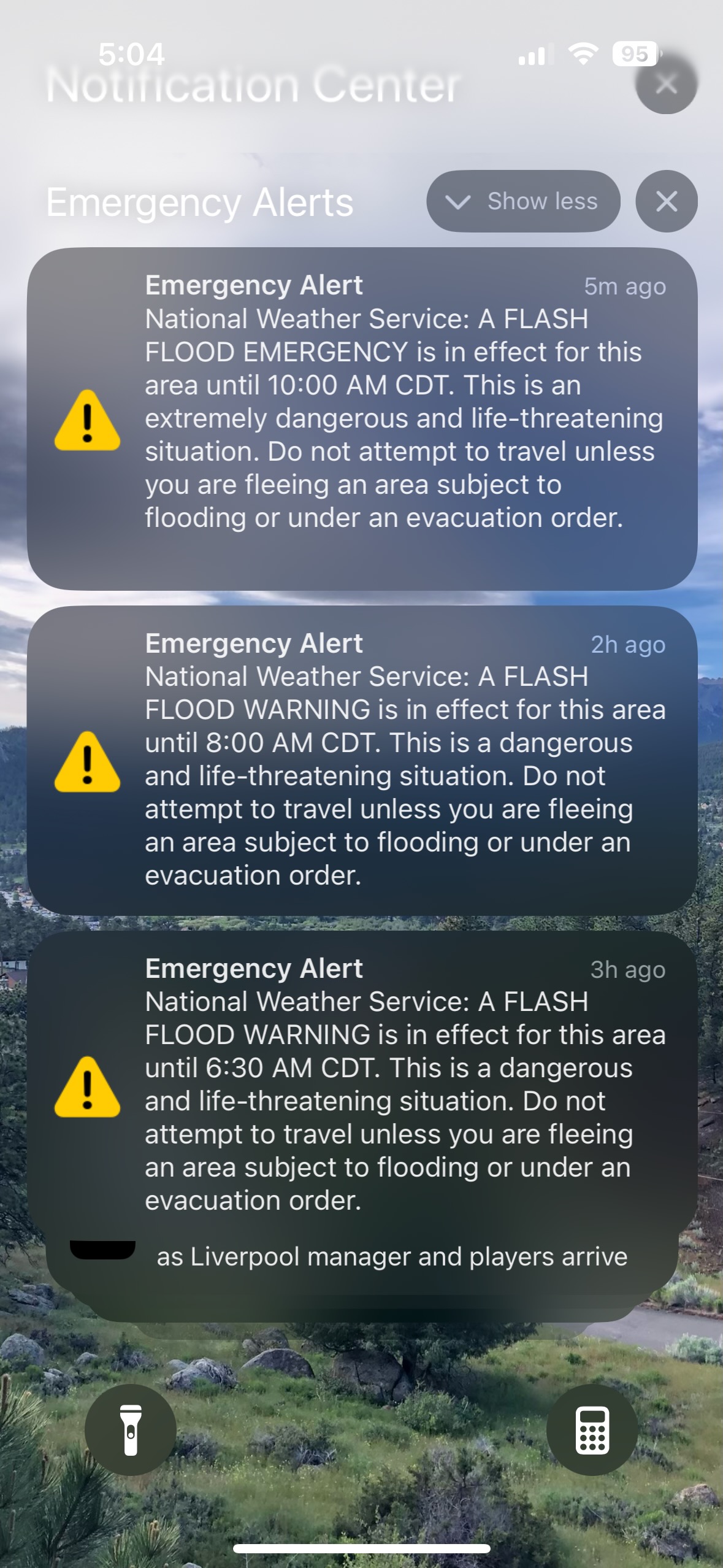
When I stagged outside my bedroom to my living room, I really couldn’t believe my weatherstation.
We’d started the day with 1.21" of rain on the month. We had…rather more than that.
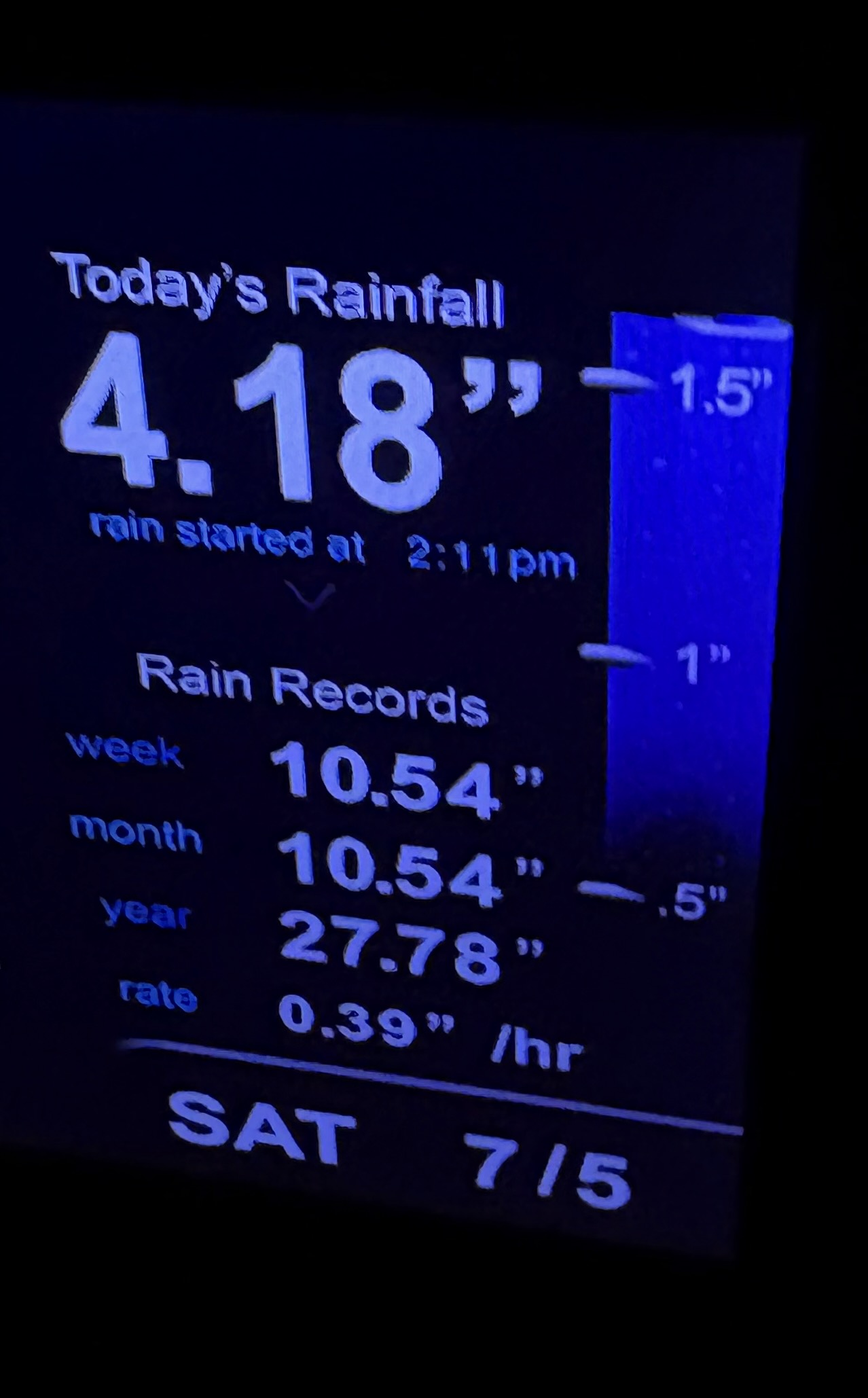
That’s 9 inches of rain since around 9pm. I looked through the records and we recorded rain rates of 5" to 6" per hour at points. Just as with the storm over Camp Mystic, the storm remained stationary for 6+ hours.
I knew this would be bad, but I didn’t know just how bad. As of this writing, we still don’t know, fully.
Saturday was largely shock and denial. I slept maybe 2 hours and got up acting like everything was normal. Our proparty was fine, afterall. I insisted on going out in my 4WD Toyota Tundra to see if the roads were passable and make an H-E-B run that we’d scheduled for 11:30 am.
I drove north and then East on a small one-lane road towards a bridge I knew might be dodgy. I saw all the normal debris we see after a gully-washer: branches, twigs across the road. I saw ponding water upstream but not downstream (should’ve been a clue…), then I sighed in relief when I saw the approach to the bridge was clear.
Then I got halfway over the bridge.
The bridge is normally 20+ feet above the North San Gabriel river. As I got there it was about 5’ over the N. San Gabriel. I’d seen this before, in Eastern Kentucky. This was a river full of anger and extra energy, not a river that’d crested. But I figured I could get to H-E-B and get back before it became an issue.
Yeah….about that….
So I got back 90 minutes later with groceries to the sight of cars going the other way flashing their lights. Wanting to see it for myself, I pushed on, and saw: The bridge itself was still fine, but the West approach was now…the river.
So, I backtracked into Liberty Hill and came up my normal route, across two bridges that looked like extras out of “The Road Warrior”–they were intact and structural, but missing swathes of pavement, guardrails, and adorned with all sorts of debris from being overtopped in the torrents overnight.
From there, I just stayed put the rest of the day, mostly from what I laughingly termed as Whitneys “If he doesn’t die, I’ll kill him!” concern for my wellbeing.
From there it’s been the general rollercoaster lived out on social media:
- Some of the missing girls have been found alive, 2 miraculously this afternoon clining 27 feet up a tree.
- Wild speculation. At one point there was a post where they’d “Found the camp director and all the girls alive” that proved false.
- There’s been a meta-argument going on about:
- People saying this is Karma for Texas voting republican
- Others horrified by the above asking them to piss off.
- Others who can’t undertand why either of the other two groups are speaking at all
The biggest difference with the today’s flooding is its attack on vital infrastructure. US183 is a key corredor from Austin to North Central Texas. For periods yesterday, 2 bridges over the North and South San Gabriel were blocked as “Officers can see through 2 inch cracks in the bridge to the water below”. They’ve reopened. The same happened with bridges in Georgetown at Austin Avenue and Ronald Reagan Boulevard in Williamson County.
July 6th: The Aftermath?
Church this morning was a wake, a collection of people in shock. We don’t quite know who’s dead, who’s alive, and who needs help. County services are swamped but they’re trying. They’ve asked people to stay home.
As I write this, it’s 5:35 pm. We’ve received another Flash Flood Warning and it’s raining at 2.93" per hour on my weather station. There’s just word of another (unidentified) body found at 1869, and still the other shoe to drop of the many missing. At this point, we’re looking at at least 75 dead.
Wde’ve received 11.5" since July 4th. It’s still raining.
And we’re still hoping.